Showing posts with label Defence News. Show all posts
Showing posts with label Defence News. Show all posts
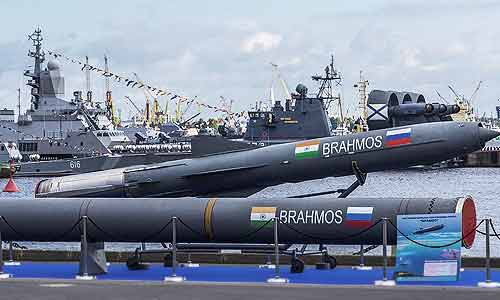
The first export contract for the supplies of the BrahMos cruise missiles to a foreign customer can be signed before the end of this year, Alexander Maksichev, a spokesman for the Russian-Indian company Brahmos Aerospace, informed TASS at the 14th International Maritime and Aerospace Exhibition LIMA 2017.
"I believe the first export contract for the delivery of the BrahMos missiles can be signed until the end of 2017," he said without specifying the potential customer. Maksichev emphasized that the consent of the Russian and Indian governments is required for exporting these missiles to third countries.
He did not specify though which modification could be exported - sea or land-based. According to Maksichev, it is planned to adapt the BrahMos-ER (extended range) missiles tested in March 2017 for naval applications.
Now Export Contract for Brahmos Missiles could be signed before year-end 2017

India’s rising military strength seems to have rattled both China and Pakistan. According to the Chinese Communist Party’s official organ The Global Times, China is contemplating to produce ballistic, cruise and anti-aircraft missiles in joint collaboration with Pakistan.
Until recently, Beijing was in the habit of pooh-poohing India as a military power. But the Agni V missile with its five thousand plus kilometre range and the recent successful trial of the nuclear capable submarine launched ballistic missile (SLBM) K-4 with a reported range of 3,500 kms have made Beijing sit up and take note.
The Indian Navy has also drawn up an ambitious expansion plan which aims at raising the navy’s fleet strength to two hundred vessels by 2025 and transform it from a buyer’s navy to a builder’s navy, posing a serious challenge to China’s ambition of dominating the high seas in Asia.
Besides, the situation in South Asia has been gradually turning against China. Its ‘string of pearls’ policy of encircling India has failed. Rather, its aggressive assertion of unilateral claim over the South China Sea has antagonized Japan, Vietnam, the Philippines, Malaysia and Indonesia. India’s decision to sell the BrahMos missile to Vietnam has raised Beijing’s hackles.
China’s influence on Sri Lanka and Myanmar has also waned considerably. Instead of isolating India, China finds itself getting isolated from most of her neighbours. Joint naval exercises by India, Australia, Vietnam and US in the Malabar Coast have been another worry for China.
In fact, barring Pakistan China today has hardly any Asian country which it can count as its all-weather friend. China may fume and fret over Dalai Lama’s coming visit to Tawang in Arunachal Pradesh but it knows that a repetition of 1962 will no longer be possible. Donald Trump is yet another imponderable factor for China. Beijing does not know whether militarization of the South China Sea will invite Trump’s retaliation. It would be very risky to do so.
As for Pakistan, it no longer enjoys the same rapport with the US as it did earlier. China is hardly likely to replace the US as a donor country helping Pakistan militarily and economically. The growing China-Pakistan axis may not win Beijing many friends in Asia. China considers India as its main rival as a regional power but finds that containing India is becoming more and more difficult. It is for the policy-makers in Beijing to decide whether they will take a confrontationist or a conciliatory attitude to India.
China-Pak unable to contain India's Rising Military Strength and Global Diplomacy Streaming

Nearly a fortnight after the surgical strikes in September 2016, Pakistani snipers took out sepoy Sudesh Kumar of 6 Rajput regiment who was on patrol along the LoC in Rajouri. A week later, they struck again, killing BSF jawan Gurnam Singh with a shot to the head in Hiranagar sector, Jammu. Two bullets from a Pak sniper caught rifleman Sandeep Singh Rawat in the neck, killing him instantly as he stood guard along the fence in the Kupwara sector.
In the last four months, over a dozen Indian soldiers have died at the hands of Pakistani snipers. A shortage of the lethal lone wolves, outdated technology and absence of specialised training programmes are fraying India’s edge in covert border warfare. Lack of official acknowledgment in the form of awards and citations is a deterrent to getting fresh recruits.
Indian snipers use only technologically obsolete Russian-made Dragunov rifles of 1960s vintage along the LoC. Acknowledging its slipping edge, an internal report of the Army HQ stated, “Snipers are force multipliers to any infantry battalion. The high standard of sniper training and their imaginative employment leads to decisive and out-of-proportion results.”
The Army started its hunt to replace the Dragunovs around 2012, but the infantry is yet to get new, up to date weapons. Indian Army has two snipers per battalion deployed at the Line of Control.
Little training and outdated equipment have led to India’s slipping sniper edge over Pakistan. Pakistani shooters use modern sniper scopes on their Austrian Steyr SSG .22 rifles. Crawling through thick vegetation, they take up position to monitor Indian troop movement and choose targets. Pakistan snipers are posted permanently at border outposts, while before the surgical strikes they were requisitioned on operational requirement.
“To achieve effective results out of the precision fire of a sniper rifle, it is important that the forced incidental errors due to environmental factors be reduced to minimum,” the Army’s internal report said. It identified hi-tech sniper scopes for small teams to be regularly deployed in counter-terror ops in the plains and high altitude areas up to 20,000ft, such as Siachen, where light and wind factors play an important role in shooting accuracy.
“These sniper detachments operate in conditions where judging distance and cross wind error component adversely affects the external ballistics before the bullet strikes the target. The new sniper scope with inbuilt distance and cross wind component correction will help the sniper to engage with precision,” the report stated while stressing on the need for institutionalised training for Indian snipers.
The Army is compensating the gap by using conventional styles of target engagement and distance assessment. “Third generation telescope sights are accurate to an extent in measuring distance but it requires extensive training at long range. Laser range finders and hand-held thermal imagers are being used to measure accurate distance.
However, it imposes the penalty of additional battle load on the sniper detachments,” the Army report added by saying that optical refracting telescope with variable magnification sites are being used by many armies. However, these sights don’t cater for high-speed cross winds and rarefied air in high altitude areas.
Even the BSF, in view of the rising incidents of sniper fire from Pakistan, has taken preventive measures such as placing nets in border outposts and Observation Posts. A 10-metre high embankment will be built along the LoC too.
Indian Army losing sniper edge over Pakistan on LoC Border

India will boldly go to Venus for the first time and re-visit the Red Planet very soon.
Buried and hidden in the hundreds of pages of the new format electronic budget documents, is the first formal acknowledgement by the government about these two new bold inter-planetary sojourns to Earth's immediate neighbours.
This uplifting news comes ahead of the Indian Space Research Organisation (Isro) attempting to undertake its mega launch where it will drop off into space not one, two or three but a full load of 104 satellites in space in a single mission.
No other country has ever tried to hit a century in a single mission. The last world record is held by Russia which in 2014 rocketed 37 satellites in a single launch using a modified inter-continental ballistic missile.
If all goes according to plan, on the morning of February 15, Isro will hurl into space using the Polar Satellite Launch Vehicle (PSLV) three Indian satellites and a 101 small foreign satellites.
India is hoping to better the previous world record by a whopping two-and-a-half times. Isro, considered the new kid on the block in the multi-billion dollar world launcher market, hopes to set an enviable benchmark for the space fairing nations.
Prime Minister Narendra Modi's love affair with space is quite evident. The government, it seems, is rather pleased with the Indian space agency as finance minister Arun Jaitley gave the department of space a whopping 23 per cent increase in its budget. Under the space sciences section, the budget mentions provisions "for Mars Orbiter Mission II and Mission to Venus".
The second mission to Mars is tentatively slated for in 2021-2022 timeframe and as per existing plans it may well involve putting a robot on the surface of the Red Planet.
While India's first mission to Mars undertaken in 2013 was a purely Indian mission, the French space agency wants to collaborate in making the Mars rover.
In fact on a visit to India this month, Michael M Watkins, director of the Jet Propulsion Laboratory of Nasa, said they would be keen to at least put a telematics module so Nasa's rovers and the Indian satellites are able to talk to each other.
The second Indian mission to Mars is likely to be all about doing good science since the first one had a nationalistic streak on it in trying to beat China to the orbit of Mars which the Mars Orbiter Mission (MOM) did magnificently.
India's maiden mission to Venus, the second planet of the Solar System named after the Roman goddess of love and beauty, is in all probability going to be a modest orbiter mission.
Watkins said a mission to Venus is very-very worthwhile as so little is understood about that planet and Nasa would definitely be willing to partner in India's maiden voyage to Venus.
Towards that, Nasa and Isro have already initiated talks this month on trying to jointly undertake studies on using electrical propulsion for powering this mission.
India's original inter-planetary dreamer K Kasturirangan, former chairman of Isro, says, "India should be part of this global adventure and exploring Venus and Mars is very worthwhile since humans definitely need another habitation beyond Earth."
Closer to home on its 39th launch India's workhorse rocket the PSLV will lift off carrying 1378 kg of robots to be deployed in space.
The first to be let off will be India's high resolution Cartosat-2 series satellite made especially to monitor activities of India's hostile neighbours at a resolution of less than a metre keeping a bird's eye view on both Pakistan and China.
This earth imaging capability is not unusual but the rest of the passengers are unique. There are two small Indian satellites each weighing less than 10 kg that are forerunners of a new class of satellites called Isro Nano Satellites which the engineers seek to master.
What follows next is a trailblazing performance by the PSLV when at an altitude of over 500 km in space it will release from its womb, 101 co-passengers one each from Israel, Kazakhstan, The Netherlands, Switzerland, the UAE and a whopping 96 from the US. It is only recently American private companies have warmed up to Isro as India offers cheap and reliable option.
88 of the American satellites belong to a San Francisco based start-up company Planet Inc which is sending a swarm of small 4.7 kg each satellite it calls 'Doves'. This constellation will image earth like never before and with a high repeat rate providing satellite imagery at an affordable cost.
This suite of 101 small satellites all together weighing 664 kg will be released in space in a manner akin to a typical school bus which drops of its passengers namely children at their respective bus stops in a sequential manner, avoiding squabbling and elbowing in near zero gravity is not easy.
Ensuring that no collisions take place even is an art that Isro has mastered from previous launches. In less than 600 seconds all 101 satellites will be released into space each travelling at whopping velocity of over 27,000 km per hour or at 40 times the speed of an average passenger airliner.
Some experts are suggesting that in a bid to earn some money Isro is actually contributing significantly to the creation of space junk as these small satellites are really not very useful.
But Laura Grego, Senior Scientist, Global Security Program, Union of Concerned Scientists, Cambridge, USA says, "I think that these launches can be done responsibly and provide benefits to all people. Developing a culture of responsible space launch and operations is key as more and more countries become space-faring.
"While the number of countries that can launch satellites independently is still quite small, many dozens of countries own and operate satellites."
Kasturirangan says, "India has the capability putting several satellites in a single launch and demonstrating that capability is certainly not bad as it adds to India's credibility and then later if Isro deploys this capability of formation flying in a constellation of its own satellites it would be a useful addition to its arsenal."
With an eye on Venus and Mars, ISRO attempts mega World Record
Subscribe to:
Posts
(
Atom
)